


Linear Graphs and their Equations - Questions
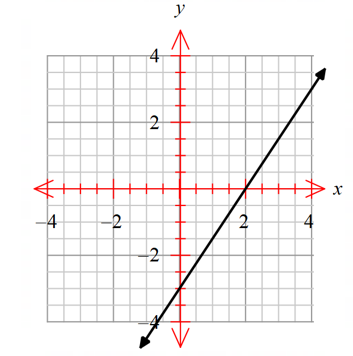
Which equation represents the adjacent graph?
\(\dfrac{x}{2} - \dfrac{y}{3} = 1\)
\(\dfrac{x}{3} - \dfrac{y}{2} = 1\)
\(\dfrac{x}{2} + \dfrac{y}{3} = 1\)
\(\dfrac{x}{3} + \dfrac{y}{2} = 1\)
\begin{align}
&\text{The intercepts are } (2,0) \text{ and } (0,-3)\\
&\begin{aligned}
\text{In } A: &\text{ when } y=0,\quad \; \frac{x}{2}=1 \rightarrow x=2\\
&\text{ when } x=0,\;-\frac{y}{3}=1 \rightarrow y=-3\\ &\therefore \frac{x}{2}-\frac{y}{3}=1\\
&\therefore A
\end{aligned}
\end{align}
The equation of the line that passes through the points \({\rm{A(3,}} - {\rm{1)}}\) and \({\rm{(}} - 2,1)\) is?
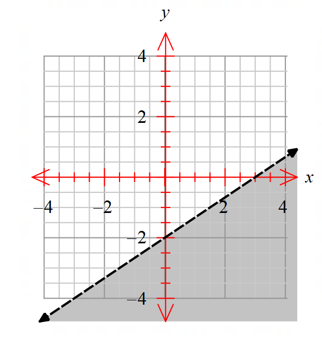
The correct inequation for the shaded half-plane in the adjacent diagram is?
\(2x + 3y < 6\)
\(2x - 3y > 6\)
\(3x + 2y > 6\)
\(3x - 2y < 6\)
\begin{align}
&\text{The intercepts of the line are }(3,0) \text{ and } (0,-2)\\
&\text{Using the intercept form of the line:}\\
&\begin{aligned}
\frac{x}{a}+\frac{y}{b}=1 \rightarrow \quad \frac{x}{3}+\frac{y}{-2}&=1 \\
2x-3y&=6 \quad \therefore \quad A \text { or } B
\end{aligned}\\
&\text{Consider B }\quad 2x-3y>6,\\
&(0,0) \text{ does not satisty this inequality. }\therefore B
\end{align}
The gradient m, and the y - intercept b of the line \(\dfrac{{2x}}{3} - \dfrac{y}{4} = 5\) are?
\begin{align}
&\begin{aligned}
\frac{{2x}}{3} - \frac{y}{4}& = 5\\
\textcolor{red}{12} \times \frac{{2x}}{3} -\textcolor{red}{12} \times \frac{y}{4} &= 5 \times \textcolor{red}{12}\\
8x-3y&=60\\
3y &=8 x-60 \\
y &=\frac{8}{3} x-20 \\
\end{aligned}\\
&\therefore m=\frac{8}{3}, \;\; b=-20
\end{align}