


Bisection and Lengths of Line Segments - Questions
The midpoint of \(PQ\) has the co - ordinates \({\rm{(}}4, - 1).\,\) \(P\) is the point \({\rm{(3}}, - 4),\,\,Q\) is the point?
The perpendicular bisector of the line segment joining \(A( - 1,2)\) and \(B(3,4)\) is?
The equation of the line with a gradient of \( - 2\) and passing through the midpoint of \(A( - 1,3)\) and \(B(5,1)\) is?
The distance between the points \(A(1,3)\) and \(B(p,1)\) is \(\sqrt {13} .\) The value of \(p\) is?
From the adjacent figure determine the
length of \({\rm{CD}}\) given that \({\rm{CD}} \bot {\rm{AB}}\)
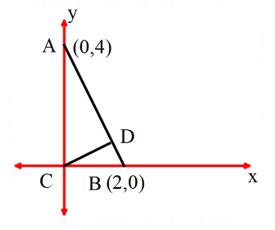
\(\begin{align}
&\textbf{Method 1}\\
&m_{AB}=\frac{4-0}{0-2}=-2 \\
&m_{CD}=\frac{1}{2}\\
&CD \Rightarrow y=\frac{1}{2} x \\
&AB \Rightarrow y=-2 x+4\\
&\text {To locate } D:\\
&\quad \begin{aligned}
\frac{1}{2} x&=-2 x+4 \\
\frac{5}{2} x&=4 \\
x&=\frac{8}{5},\; y=\frac{4}{5} \\
\end{aligned}\\
&\begin{aligned}
\therefore CD&=\sqrt{\frac{64}{25}+\frac{16}{25}}\\
&=\frac{\sqrt{80}}{5}\\
&=\frac{4 \sqrt{5}}{5}
\end{aligned}
\end{align}\)
\(\begin{align}
&\textbf{Method 2}\\
&\text{Area of }\triangle ACB=\frac{1}{2} \times 2 \times 4=4\\
&\begin{aligned}
BA &=\sqrt{(0-2)^{2}+(4-0)^{2}} \\
&=\sqrt{20} \\
&=2 \sqrt{5}
\end{aligned}\\
&\begin{aligned}
\text{Let } CD&=h \\
\therefore 4 &=\frac{1}{2} h \times 2 \sqrt{5} \\
h&=\frac{4}{\sqrt{5}} \times \frac{\sqrt{5}}{\sqrt{5}} \rightarrow CD=\frac{4 \sqrt{5}}{5}
\end{aligned}
\end{align}\)