


Vector Problems - Questions

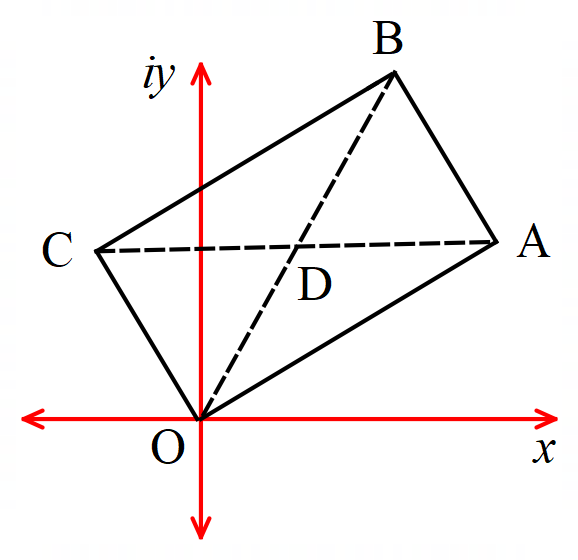
In the Argand diagram ,OABC is a rectangle, where \({\rm{OA}} = {\rm{2OC}}\). The vertex A corresponds to the complex number \(\omega \). The diagonals OB and AC intersect at D. The complex number that represents D is?


On a complex plane, \(P\) represents \(z = 2 + i\) and \(Q\) represents a complex number \(\omega \). Given that \({\rm{OPQ}}\) is a right - angled triangle with a right angle at \(O\), then \(\omega = \,\)?
\( - 1 + 2i\)
\( - 2 + i\)
\(2 + i\)
\( - 1 - 2i\)


Given that, on the Argand diagram the points A and B represent the complex numbers \({z_1} = 1 + 11i{\rm{ }}\) and \({\rm{ }}{z_2} = 5 + i{\rm{ }}\) respectively, and \(\overrightarrow {{\rm{OM}}} \) bisects the side \(AB\) and given that \(P\) divides \(OM\) in the ratio 2:1, then \(P\) represents the complex number:
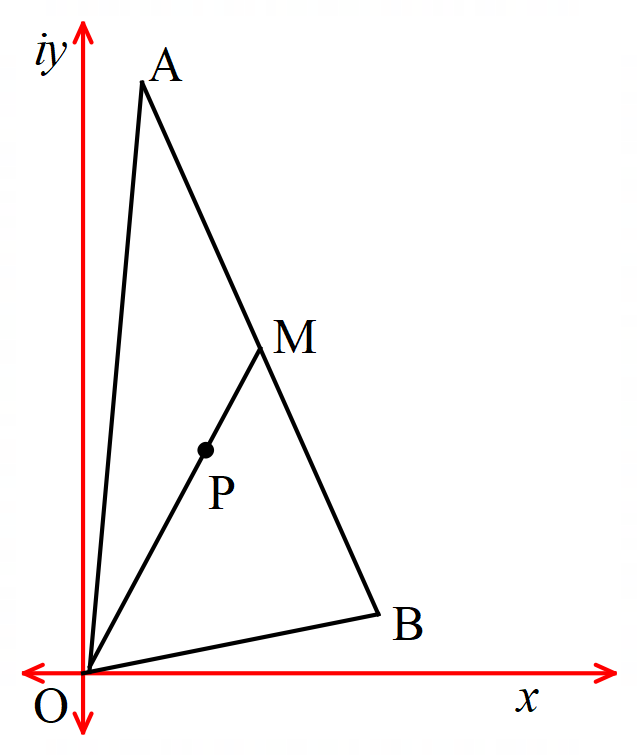


The point \(A\) in the complex plane corresponds to the complex number \(\omega \). \(\Delta AOB\) is a right-angled isosceles triangle, where \(AB=AO\) and \(M\) is the midpoint of \(OB\).
(i) Explain why vector \(OB\) corresponds to the complex number \((1 + i)\omega \) (2 marks)
(ii) What complex number corresponds to the vector \(AM\)? (3 marks)
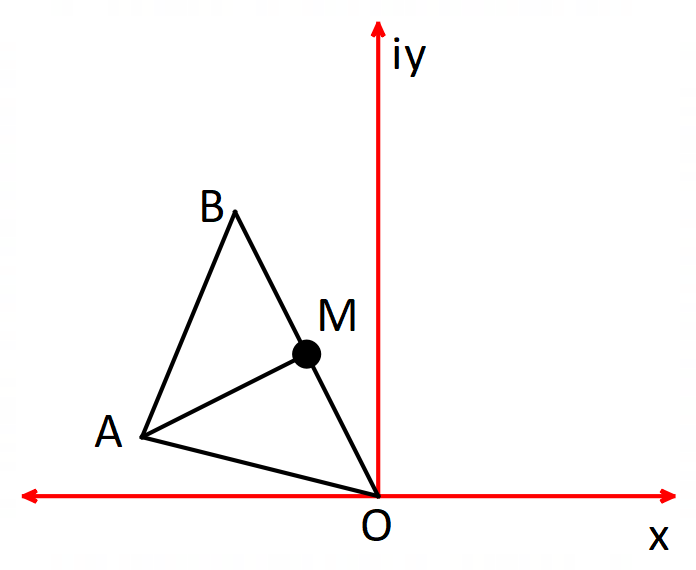

On the Argand diagram, let \(A\) represent \({z_1} = 1 + i\sqrt 3 \), let \(B\) represent \({z_2} = 2(\cos \dfrac{{2\pi }}{3} + i\sin \dfrac{{2\pi }}{3})\) and let \(C\) represent \({z_3} = {z_1} + {z_2}\).
(i) Find the coordinates of \(C\) (3 marks)
(ii) Find the area of the rhombus \(OABC\) (2 marks)
